Shopify Festive Season Sales: 9 Conversion Fixes Before Diwali
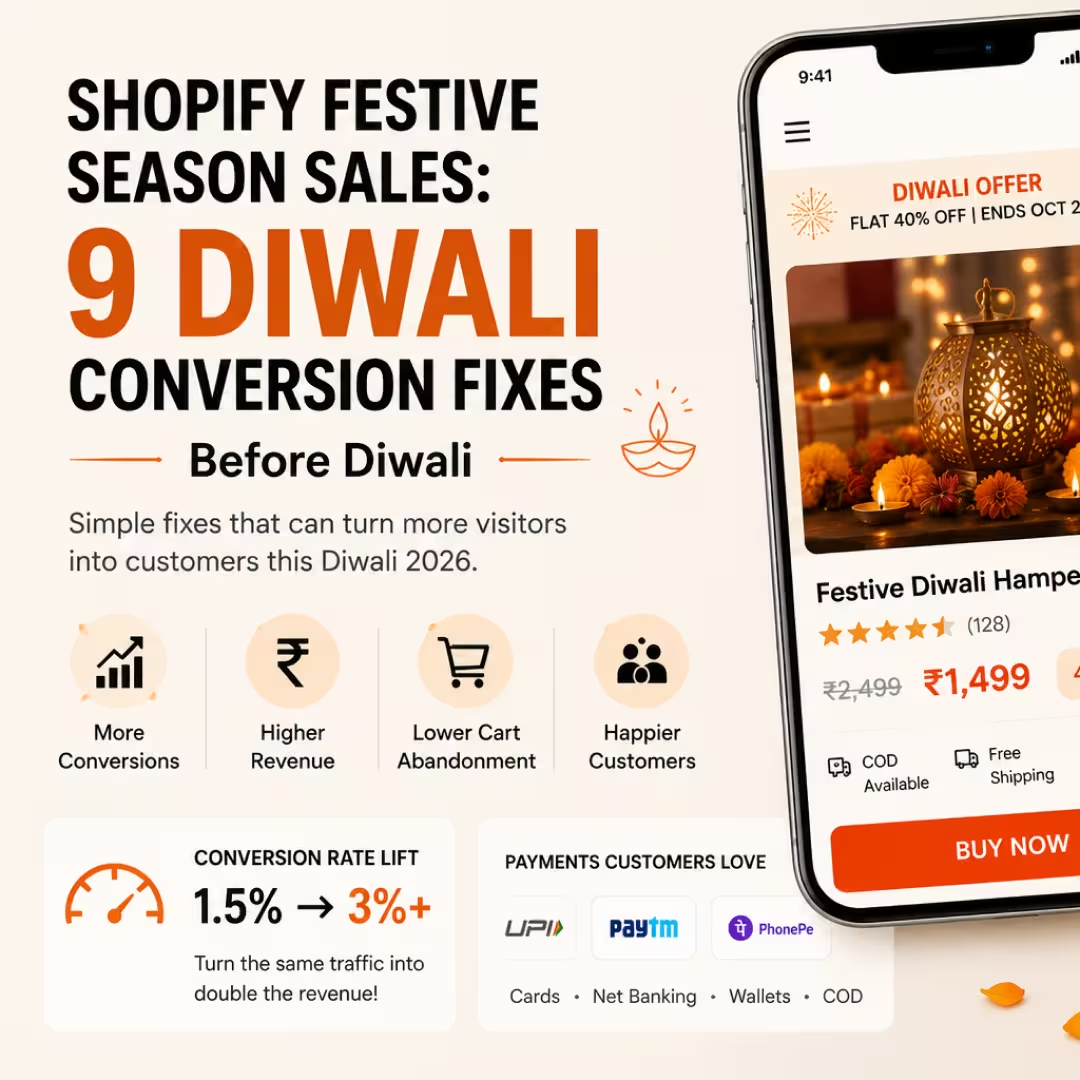
Diwali 2026 lands on October 20-21, which gives Shopify merchants in India a narrow runway to fix the leaks in their funnel before the festive rush. The nine conversion fixes that matter most are: a guest-friendly one-page checkout, a single festive offer above the fold, sub-three-second mobile load times, UPI-first payment options, honest urgency messaging, transparent COD and shipping costs, automated abandoned-cart flows, trust signals at the point of hesitation, and a post-Diwali retention plan. Stores that complete these fixes before the festive traffic spike typically lift conversion rates from a baseline of 1.5-2% toward 3% or higher — turning the same ad spend into nearly double the revenue.
Why the festive season decides your entire year
Festive season sales drive more than 40% of annual online revenue for Indian ecommerce, and Diwali is the single biggest window inside that season. For a Shopify store doing steady volume in a normal quarter, the festive quarter can deliver a disproportionate share of annual profit — but only if the store actually converts. Festive traffic behaves differently from August traffic. Shoppers compare faster, bounce faster, and abandon carts more readily because every competitor is running a sale. Conversion optimization is the difference between paying for clicks and banking them.
If your theme or checkout needs surgery rather than a facelift, this is exactly the work a Shopify Development Agency gets booked for in September. It is also why Ecommerce Website Development Delhi teams run waitlists by October — rebuilding a store mid-season is always more expensive than preparing in advance.
Diwali 2026: the dates and your real runway
Diwali 2026 falls on October 20-21, with Dhanteras around October 17-18. Here is the festive calendar Shopify stores should plan against:
- Dhanteras (Oct 17-18): high-intent shopping for electronics, appliances, gold, and kitchenware
- Naraka Chaturdashi and main Diwali (Oct 20-21): peak gifting, sweets, apparel, and decor purchases
- Bhai Dooj and wedding-season spillover (late Oct-Nov): a second, smaller demand wave
- Marketplace events: Flipkart Big Billion Days and Amazon Great Indian Festival typically bracket this window in early-to-mid October, training shoppers to expect deals everywhere
The practical takeaway: your store should be festive-ready by October 10 at the latest. After that, you are paying rising ad costs with a site that still leaks conversions.
The 9 conversion fixes, in priority order
1. Cut checkout down to one page with guest mode
A one-page checkout with guest purchase reduces abandonment more than any discount code you can offer. Shopify’s native checkout already supports this — make sure you are not forcing account creation before payment. Every extra field between “Buy now” and “Paid” costs you roughly 5-10% of ready buyers.
2. Put one festive offer above the fold
Your hero banner should state one offer, one deadline, one call to action. “Flat 40% off — Diwali ends October 21” outperforms a slideshow of five campaigns, because festive shoppers decide in seconds.
3. Get mobile load time under three seconds
Most festive traffic in India is mobile, and a one-second delay can cut conversions by around 7%. Compress images to WebP, remove apps you activated in July and forgot, and test on a mid-range Android over 4G — not on your office WiFi. If the theme is the bottleneck, that is a rebuild conversation, not a plugin conversation.
4. Go UPI-first at payment
Display UPI, popular wallets, and pay-later options before cards. COD still matters in Tier-2 and Tier-3 markets, but present it as a clear option with a delivery-time note rather than the silent default.
5. Use urgency that is actually true
Countdown timers tied to real inventory or real end dates build trust. Timers that reset on refresh destroy it, and festive shoppers who feel manipulated punish you with chargebacks and one-star reviews.
6. Make COD, shipping, and delivery dates transparent on the product page
Unexpected costs are the top reason Indian shoppers abandon carts. Show COD availability and the guaranteed delivery date before checkout — festive gifting is deadline-driven, and “will it arrive before Diwali?” is the question on every product page.
7. Automate abandoned cart and browse abandonment flows
A three-email and WhatsApp sequence — one hour, 24 hours, 72 hours — with a small escalating incentive recovers 5-15% of otherwise-lost carts. Set this up before the traffic spike, not during it. If you need help building the festive campaign calendar around these flows, our Social Media Marketing Agency in India team runs exactly this kind of full-funnel planning.
8. Put trust signals where hesitation happens
Immediately near the add-to-cart button: return policy, warranty, COD availability, review count, and secure-payment logos. Social proof feeds both conversion and organic visibility — our SEO Company in Delhi, India team has covered how reviews influence rankings and AI answers in detail.
9. Plan the post-Diwali retention play now
The customer you acquire during Diwali is worth more than the single sale. Set up WhatsApp and email flows for Bhai Dooj, wedding season, and New Year before October 20 — not after. Retention is where festive CAC finally pays for itself.
Comparison table: the app stack that actually helps festive conversions
| Goal | App category (examples) | Best for | Watch out for |
|---|---|---|---|
| Urgency | Sale timer apps (Hextom, Essential) | Fast setup, low cost | Timers must be real; fake urgency destroys trust |
| Higher AOV | Bundle & upsell apps (ReConvert, Fast Bundle) | Gifting season basket size | Test on mobile first; heavy apps slow pages |
| Trust | Review apps (Judge.me, Loox) | Proof near add-to-cart | Import existing reviews before the season starts |
| WhatsApp API apps (Interakt, AiSensy) | Cart recovery and order updates | Needs opt-in compliance; segment your lists | |
| Reminders | Web push apps (PushOwl) | Last-minute festive nudges | Low opt-in rates; pair with email, don’t replace |
Frequently asked questions
Q: When should a Shopify store start preparing for Diwali sales in 2026?
A: Six to eight weeks ahead for theme, app, and checkout work — meaning August for development and October 10 for campaigns and creative. Diwali 2026 is October 20-21.
Q: How much can these conversion fixes improve sales?
A: Most stores see a 20-40% relative improvement in conversion rate. A store converting at 1.8% that reaches 2.8% earns roughly 55% more revenue from identical traffic.
Q: Do I need a developer for all nine fixes?
A: No. Checkout settings, offers, apps, and email flows are configuration-level. Speed work and theme changes usually need a Shopify Development Agency in Delhi or an equivalent partner.
Q: Are countdown timers effective for Diwali sales?
A: Yes, when they are tied to a real deadline or real stock. Artificial timers that reset on refresh raise conversions short term but trigger refunds, distrust, and negative reviews.
Q: Should I keep cash on delivery during the festive season?
A: Yes, especially for Tier-2 and Tier-3 customers. Present it transparently with any delivery-time implications rather than hiding it at checkout.
Diwali rewards preparation, not heroics. Fix the funnel while traffic is still cheap, and the festive season pays you back all year. Explore WeBeSocial’s work or talk to our team about your Shopify festive plan.